
How to plan family meals for a week without reinventing dinner every night.
By Complete OS · Published October 24, 2026
Plan from a short list of meals your family already likes, not a blank week. Pick six or seven recipes, check the calendar before you assign them so practice nights get the fast meal and Sunday gets the slow one, cook double on one or two nights so another night is just reheating, and send every recipe’s ingredients to one shared list before you shop. That one pass — recipes, then calendar, then batch, then list — is most of what “meal planning” means for a family; the rest is repeating it.
Start from six meals, not a blank week
The exhausting part of family meal planning isn’t cooking — it’s deciding, from nothing, seven times a week. Skip the blank page. Write down six or seven dinners your household already eats without a fight: two the kids love, two you could make with your eyes closed, one that uses up whatever’s in the fridge, one that’s genuinely new.
That list is your rotation, not your whole life. You’ll repeat it most weeks with one swap, and repetition is the point — a familiar recipe takes less mental effort and less time to shop for than a new one every night.
Check the calendar before you assign a single meal
Look at the week before you decide what’s for dinner, not after. Practice nights and late meetings get the fastest meal in your rotation or planned leftovers; the one night everyone’s actually home gets the recipe that takes longer. A meal plan built without looking at the week first is the one that falls apart by Wednesday.
If someone in the house works a shift, the plan needs to follow their hours, not a fixed 6 p.m. dinner clock — put their meal on the day and time they’ll actually eat it, even if that’s breakfast at 4 p.m.
Cook once, eat twice
Pick one or two nights to cook a double batch — a pot of chili, a tray of roasted chicken, a big pan of baked ziti — and plan a second, differently-named meal from the leftovers two or three days later: chili over rice becomes chili-cheese baked potatoes; roasted chicken becomes chicken tacos. That’s one cooking session covering two dinners, and it’s the single biggest time-saver in a weekly plan.
Write the leftover meal into the plan by name on its own day, even if the name is just “chili, round two.” A plan that only lists the original cook puts the decision right back on your plate later in the week.
Build one shopping list, not three
Once the week’s meals are picked, go recipe by recipe and add every ingredient to one list — don’t shop from memory or from a mental list that misses whatever you ran out of on Tuesday. A few shoppers use a fixed-category method to keep the list from sprawling: the 5-4-3-2-1 method buys five vegetables, four proteins, three fruits, two carbs and one treat; the simpler 3-3-3 rule buys three proteins, three carbs and three fats and mixes them into the week’s meals. Either works as a starting shape — the point is a limit, not a strict rule.
Whatever method you use, check what’s already in the fridge and pantry before the list, not after, so you don’t buy a third jar of peanut butter.
Bring the rest of the household into the plan, not just the decision
A meal plan one person builds alone and defends all week is a chore. A meal plan the household can see and add to is a system. Let anyone add a request to the week (“can we do the ziti again?”), and once the list exists, let anyone shop from it and check things off — the person doing the deciding doesn’t have to be the only person doing the buying.
If the household is feeding four or more on a tight budget, the math still works: a shopping list built from a short recipe rotation and planned leftovers, at a discount grocer, has gotten a week of dinners for four under $100 in published grocery hauls — though store prices vary enough by region and year that no single number is a promise, and that total usually assumes basics like oil and spices are already in the pantry.
How Complete OS runs this for a household
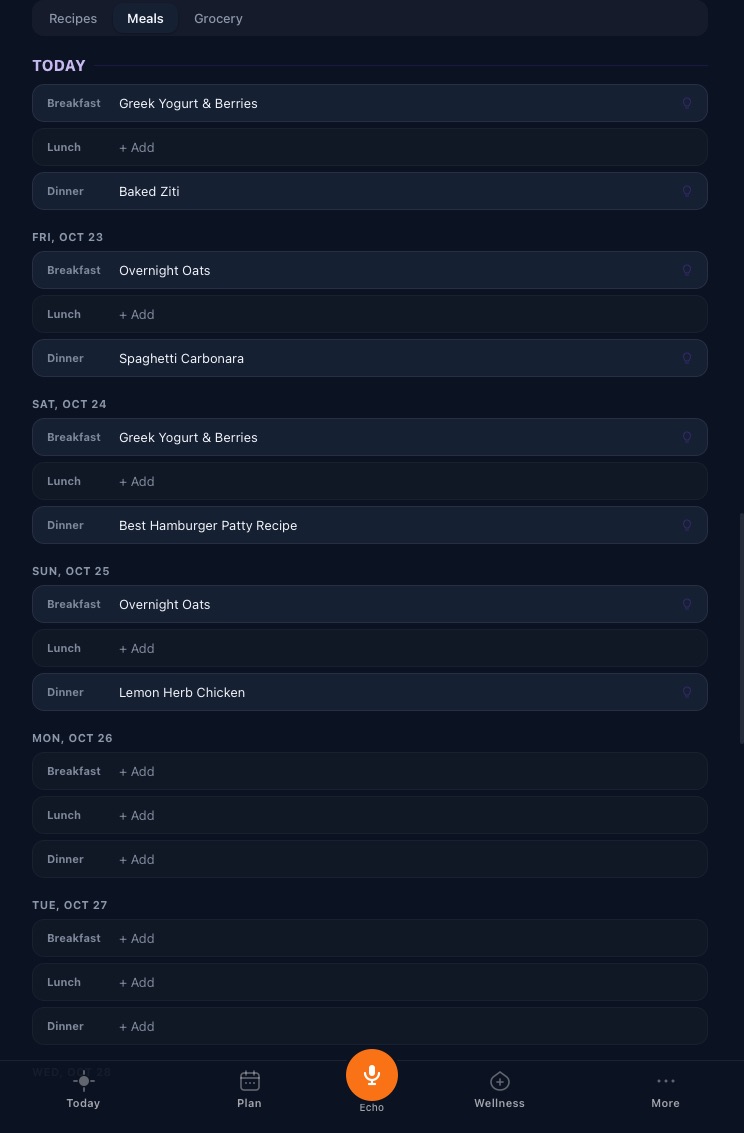
Complete OS puts the rotation, the calendar and the list in one place instead of three. Save your six or seven go-to meals as recipes in the Kitchen — type them in by hand, paste a recipe link to fill one in, or start from the built-in starters — then drop them onto the days of the week in the Meals tab, a grid you can leave partly empty or repeat from last week.
Create a household in Settings and invite your partner or kids with one invite code; recipes are shared with the household by default, so a meal one person plans shows up for everyone, and each person decides which of their own meals and notes stay private. Open any recipe and send its ingredients to the grocery list in one tap — an ingredient already on the list, written the same way, is skipped — and whoever’s in the store can check items off live, so two people can split the shopping and work from the same list.
Frequently asked questions
What is the 3-3-3 rule for meal prep?
A shopping framework: buy three protein sources, three carbohydrate sources and three fat sources for the week (for example chicken, eggs and yogurt; rice, potatoes and oats; olive oil, peanut butter and almonds), then mix them into different meals. It’s a shape for the list, not a diet — add fruit and vegetables on top.
What is the 5-4-3-2-1 rule for groceries?
A category limit for your grocery list: five vegetables, four proteins, three fruits, two carbohydrate sources and one treat item. It’s meant to stop impulse buys and overbuying, not to cover every staple — you’ll still need milk, eggs and pantry basics on top of it.
How do I make a 7-day meal plan for my family?
Pick six or seven meals your family already likes, look at the week’s calendar first so busy nights get the fastest meal, plan one or two nights to cook double so another night is just leftovers, then send every recipe’s ingredients to one shopping list before you shop.
How can I feed a family of 4 for $100 a week?
It’s been done at discount grocers by leaning on a short list of staples reused across several meals (rice, eggs, chicken, frozen vegetables) and planning instead of shopping meal-by-meal — but prices vary by store and region, pantry basics usually aren’t included in that total, and no plan can promise an exact number.
How do I meal plan around different family schedules?
Check the calendar before you assign meals, not after. Put the fastest meal in your rotation on practice nights and late-meeting nights, and if someone works a shift, plan their meal around when they actually wake and eat rather than a fixed dinner hour.
What’s a good app for planning meals as a family?
Complete OS keeps a shared recipe library, a weekly meal plan and one household grocery list in the same app, so a meal one person plans and the ingredients it needs are visible to everyone. It’s $9.99 a month with a 14-day free trial, no card required.